- advertised monthly starting pay at dispatch companies and eikaiwa chains in 2026, about $1,250 to $1,750 before deductions
- ¥200,000 to ¥280,300
- first-year JET Programme salary as of April 2026, about $25,100 a year
- ¥4.02 million
- assistant language teachers in Japanese public schools in December 2023, of whom 28% came through JET (MEXT)
- 18,127
On this page
Teaching English in Japan comes down to four kinds of jobs: assistant language teacher (ALT) in a public school, teacher in a private conversation school (eikaiwa), licensed teacher in an international school, and university lecturer. The first two hire graduates with no experience and pay ¥200,000 to ¥280,300 a month (about $1,250 to $1,750) in 2026, while the JET Programme pays ¥335,000 a month in the first year. You need a bachelor's degree, an employer that sponsors your status, and a clear view of the contract before you sign. Amounts are converted at about 160 yen to the dollar, the rate of mid-November 2026.
English teaching jobs in Japan: the four routes compared
The table gives the order of magnitude for each route. Salaries are gross monthly figures taken from employer pages and job adverts read in November 2026, detailed with their sources in the next section.
| Route | Monthly pay before deductions | Hours | Contract | Housing |
|---|---|---|---|---|
| ALT with the JET Programme | ¥335,000 in year 1, ¥360,000 in years 4 and 5 ($2,094 to $2,250) | About 35 a week, Monday to Friday | 12 months, renewable up to 5 years in total | Depends on the local authority that employs you |
| ALT with a dispatch company | ¥200,000 to ¥255,000 ($1,250 to $1,594) | School day, roughly 8:00 to 17:00 | 1 year, April to March, sometimes without August | Not provided, help finding a flat |
| Eikaiwa chain | ¥220,000 to ¥281,875 ($1,375 to $1,762) | 35 to 40 a week, evenings and weekends | 1 year as an employee, or pay per lesson as a contractor | Furnished flat at some chains, help at others |
| International school | ¥300,000 to ¥650,000 ($1,875 to $4,063), by advert | Full school timetable | 1 to 2 years, teaching licence required | Allowance at some schools |
| University, part time | Paid per 90-minute class, for example ¥12,000 ($75) | A few classes a week per campus | One academic year, renewable | None |
Most foreign teachers start in the first three rows. In its survey of December 2023, the education ministry (MEXT) counted 18,127 ALTs in public elementary, junior high and high schools. Only 28% were JET participants. Another 34.1% worked for dispatch companies, 20% were hired directly by a local board of education and 17.9% fell under other arrangements. The best-paid route is the minority one.
Teaching English in Japan salary in 2026, employer by employer
No guide in the first page of results gives pay by employer with a date, so we went to the recruitment pages and adverts. Where an employer's own page was unreadable, the figure comes from an advert it placed on a job board and we say so.
| Employer | Type | Advertised pay | Source and date |
|---|---|---|---|
| JET Programme | ALT, public body | ¥4,020,000 a year in year 1, ¥4,140,000 in year 2, ¥4,260,000 in year 3, ¥4,320,000 in years 4 and 5 | JET Program USA contract page, rates as of April 2026 |
| Interac | ALT dispatch | About ¥2.4 to ¥3.0 million a year in 12 equal payments, so ¥200,000 to ¥250,000 a month | Interac job description, rates of July 2024, the latest published |
| Borderlink | ALT dispatch | From ¥200,000 a month, or from ¥10,000 a day | Borderlink ALT job page, read November 2026 |
| Altia Central | ALT dispatch | ¥240,000 to ¥255,000 a month | Job board adverts and General Union, February 2026 |
| NOVA | Eikaiwa | ¥220,000 to ¥250,000 a month as an employee | NOVA advert on Teach Away, 10 November 2026 |
| AEON | Eikaiwa | ¥275,000 a month | AEON advert on Handshake, read November 2026 |
| Berlitz | Eikaiwa, corporate lessons | ¥275,000 to ¥281,875 a month full time, ¥1,990 per lesson part time | Tokyo job board adverts, 2026 |
| ECC | Eikaiwa | ¥280,300 a month plus a yearly performance payment | ECC recruitment site, read November 2026 |
| Gaba | Eikaiwa, one-to-one | Roughly ¥1,500 to ¥2,200 per 40-minute lesson, no guaranteed hours | Job board adverts, 2026, figures vary by advert |
Two readings of this table. First, the gap between JET and everyone else is wide: ¥335,000 against ¥200,000 to ¥280,000 for comparable entry-level work. Second, starting pay at dispatch companies has not followed the cost of living. The minimum wage rose to a national average of ¥1,177 an hour in autumn 2026 and ¥1,280 in Tokyo, so 160 hours at the Tokyo minimum are already worth about ¥205,000. For a comparison with other professions, see our page on average salaries in Japan.
ALT jobs in Japan: JET Programme, dispatch companies and direct hire
An ALT works in public elementary, junior high or high schools alongside a Japanese teacher. You do not run the class alone: you prepare activities, model pronunciation and lead parts of the lesson. The work is the same whichever employer pays you. The conditions are not.
The JET Programme
JET is the government exchange scheme, run with local authorities. As of April 2026 it pays ¥4,020,000 in the first year (about $25,100), rising to ¥4,320,000 in years four and five, for about 35 hours a week and at least ten days of paid leave. Contracts run 12 months and can be renewed up to five years in total. You apply through the Japanese embassy in your own country, usually in the autumn, for a departure the following summer, and you do not choose your placement. Selection, placements and the application calendar are covered in our guide to the JET Programme.
Dispatch companies: Interac, Borderlink, Altia Central
Boards of education that do not use JET buy the service from a private company, which hires you and sends you to the schools. Interac, one of the largest, published a gross salary of about ¥2.4 to ¥3.0 million a year in its July 2024 rates, paid in 12 equal instalments, for contracts running from 1 April to 31 March, with three to five classes of 45 or 50 minutes a day between 8:00 and 17:00. Borderlink starts at ¥200,000 a month, refunds commuting costs up to ¥30,000 a month and states that August generally falls outside the contract period, with part-time summer work offered instead. Neither company provides housing. Borderlink helps you find a flat through a partner agency, without a guarantor.
Pay is the weak point, and it can move down. According to the General Union, ALTs placed by Altia Central in Kyoto saw their monthly pay go from ¥240,000 to ¥210,000 for the 2025 to 2026 school year. After a strike in November 2025 and more than six months of negotiation, the union reported in February 2026 that the ¥240,000 rate was restored with back pay. These figures come from the union alone, as the company has not published its own account.
Direct hire by a board of education
One ALT in five is employed by the municipality itself. These posts are advertised locally, often in Japanese, and go mostly to people already in Japan with a year or two of ALT experience. Conditions vary from one city to the next, so there is no national figure to quote, but the employer is a public body, the contract follows the school year and no agency takes a margin on your salary.
Eikaiwa in Japan: AEON, ECC, NOVA, Berlitz and Gaba
An eikaiwa is a private English conversation school. Students are children after school, adults after work and companies that buy lessons for their staff, which means the timetable is the opposite of an ALT's: afternoons, evenings and weekends, with days off in the week. You teach alone, in small groups or one to one, and most chains expect you to help sell course renewals.
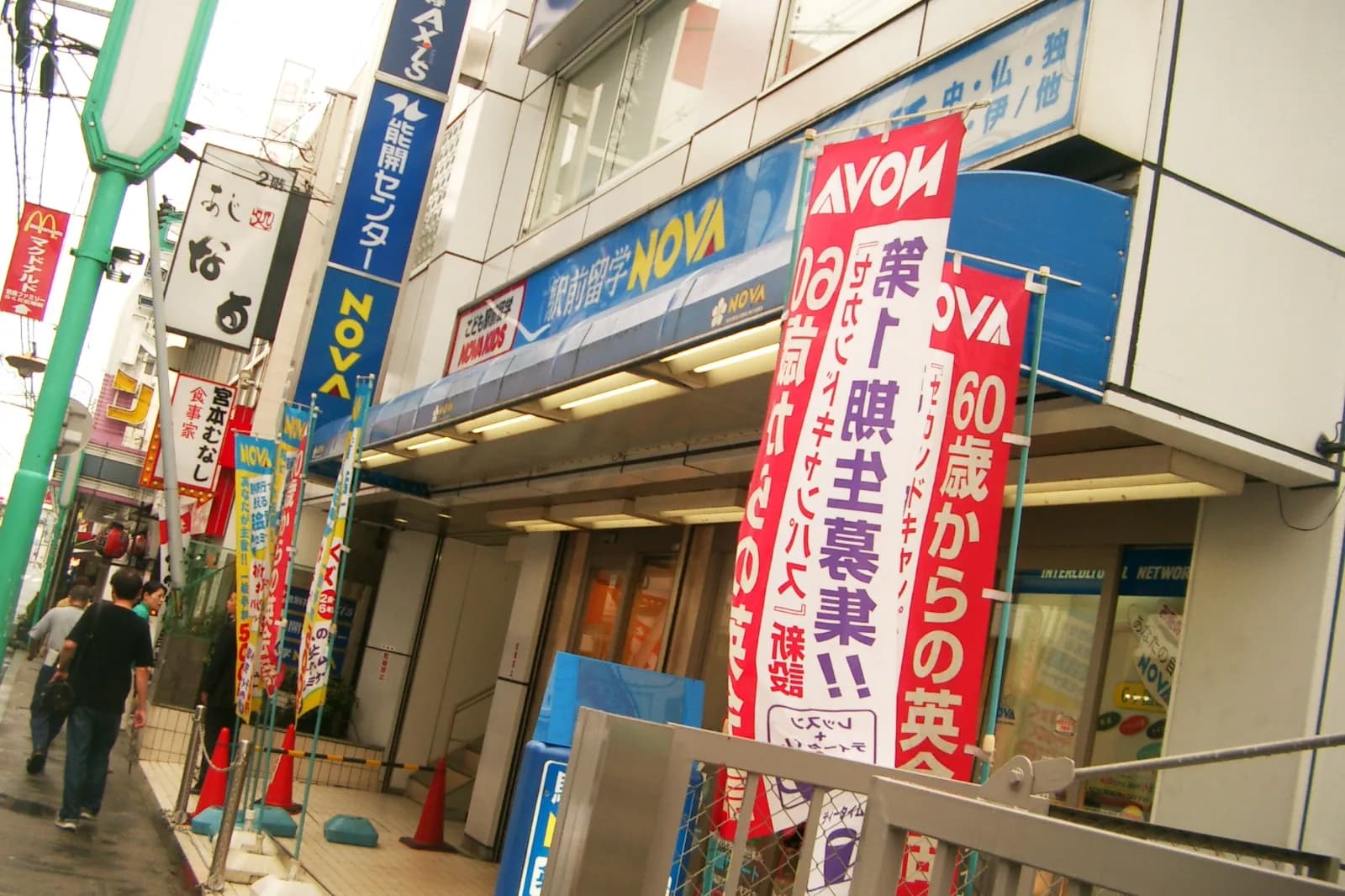
- AEON advertises a starting salary of ¥275,000 for a 40-hour week that includes teaching and office time, a furnished single apartment at a subsidised rent of ¥55,000 a month, and a bonus at the end of the last contract. You commit to one school for a year.
- ECC pays ¥280,300 for a 35-hour week, refunds train travel and helps find housing without quoting a rent. It recruits almost entirely from abroad through one-day sessions held in person, and it does not interview people who are in Japan as tourists or on a working holiday.
- NOVA offers a one-year employee contract at ¥220,000 to ¥250,000, five days a week including weekends, with an average of 160 lessons a month. It also hires independent contractors paid per lesson.
- Berlitz adverts in Tokyo quote ¥275,000 to ¥281,875 a month full time for 38 hours a week, with a large share of corporate lessons.
- Gaba pays per 40-minute one-to-one lesson, roughly ¥1,500 to ¥2,200 depending on the advert and your grade. There are no guaranteed hours, so income depends on how many of your open slots students book.
The headline salary at an eikaiwa is higher than at a dispatch company, and the contract usually runs twelve full months. The price is the schedule, the sales targets at some chains, and for per-lesson contracts the risk of a thin month.
International school and university teaching jobs in Japan
These two routes pay more and are not entry level. International schools hire subject and homeroom teachers who hold a teaching licence from their home country and classroom experience. Recent adverts give the range: ¥3,480,000 to ¥4,320,000 a year at Tokyo YMCA International School in 2024, and ¥450,000 to ¥470,000 a month (about $2,800 to $2,940) for a certified post at K. International School Tokyo in January 2026. Teach Away puts the top of the market at ¥650,000 a month. Many small schools that call themselves international are in fact English-language preschools, with pay close to eikaiwa levels.
Universities hire in two ways. Full-time lecturer posts ask for a master's degree, usually in TESOL or applied linguistics, publications and often some Japanese. Part-time posts are paid per koma, a 90-minute class taught once a week for a semester. A Tokyo advert for September 2025 at Hoshi University offered ¥12,000 per koma. Part-timers build a week from several campuses, and pay has barely moved: one university admitted in a dispute reported by Japan Press Weekly that it had given its part-time lecturers no raise between 2001 and 2024.
Teaching English in Japan: what is left at the end of the month
Gross pay says little until deductions and rent come out. The estimates below are ours. They use the fiscal 2026 rates given in our cost of living in Japan guide: about 5% of pay for health insurance and 9.15% for the employees' pension, plus employment insurance at 0.5% and withheld income tax of a few thousand yen at these salaries. They describe a first year, when no residence tax is due.
| Profile | Gross | After deductions | Rent used | Left for everything else |
|---|---|---|---|---|
| JET, first year, regional city | ¥335,000 | About ¥278,000 | ¥54,000 | About ¥224,000 ($1,400) |
| Dispatch ALT, regional city | ¥240,000 | About ¥200,000 | ¥54,000 | About ¥146,000 ($913) |
| Dispatch ALT at the starting rate | ¥200,000 | About ¥167,000 | ¥54,000 | About ¥113,000 ($706) |
| AEON teacher, company apartment | ¥275,000 | About ¥228,000 | ¥55,000 | About ¥173,000 ($1,081) |
| Eikaiwa teacher renting alone in Tokyo | ¥275,000 | About ¥228,000 | ¥78,000 | About ¥150,000 ($938) |
The rents are the cheap end of the market for a flat of up to 30 m² in our cost of living data: about ¥54,000 in Fukuoka and ¥78,000 in Tokyo's 23 wards. The same guide puts a single person's spending outside rent at roughly ¥150,000 to ¥160,000 a month for food, bills, phone, transport and leisure. A JET saves comfortably. An eikaiwa teacher breaks even or saves a little. A dispatch ALT on ¥240,000 has to live below the average budget, and one on ¥200,000 with an unpaid August cannot save at all without cheaper housing such as a share house.
Teaching English in Japan requirements: degree, passport, TEFL, age
- A bachelor's degree in any subject. It is the condition for the visa, not a preference of the schools. A TEFL certificate does not replace it.
- Twelve years of education in English for ALT work. The Instructor status asks a foreign language teacher to prove 12 years or more of schooling in that language. This is why a passport from an English-speaking country is not strictly required, and why graduates of English-medium schools elsewhere can qualify. Private chains set their own rules: ECC asks for a passport from an English-speaking country, and NOVA lists nine nationalities, from Australia to the United States by way of Jamaica, Malawi and South Africa.
- TEFL or CELTA: useful, not required. None of the employers above demands one, and all of them train new teachers. It helps most for eikaiwa posts with adults and for your own confidence in the first weeks.
- Age. Immigration sets no age limit for work statuses. The working holiday visa is limited to ages 18 to 30.
- Criminal record. The Certificate of Eligibility form asks you to declare any conviction, and the JET Programme asks candidates for a criminal record certificate from their country. A conviction does not always bar entry, but hiding one can.
- Japanese. Not required for the job or the visa. It decides how easy daily life is and how far you can go afterwards.
- Start-up money. ECC asks for at least ¥300,000 (about $1,875) on arrival and NOVA recommends ¥200,000. Interac warns that the first salary arrives six to eight weeks after the start date.
How to teach English in Japan without a degree
There is no sponsored route worth planning around. On paper, the Instructor status accepts a teaching licence in place of a degree, and the International Services category accepts three years of professional experience, but recruiters who hire from abroad ask for the degree. What remains is to hold a status that already allows work: a working holiday visa if your country is one of the 33 partners, a student visa with permission to work up to 28 hours a week, or a spouse, long-term resident or permanent resident status. Schools that offer to employ you on a tourist entry are asking you to work illegally.
Visa for teaching English in Japan: Instructor or Specialist in Humanities
The status depends on where you teach, not on what you teach. An ALT in a public school holds the Instructor status, which covers teaching in elementary, junior high and high schools. An eikaiwa or corporate teacher holds the Engineer / Specialist in Humanities / International Services status, the standard office-work status, where a university graduate hired to teach a language is exempt from the three years of experience normally asked for International Services. University lecturers fall under Professor.
| Status | Jobs covered | Main condition |
|---|---|---|
| Instructor | ALT in public schools, teacher in a recognised school | Degree or teaching licence, and 12 years of education in English |
| Engineer / Specialist in Humanities / International Services | Eikaiwa, corporate lessons, private language schools | University degree |
| Working holiday | Any teaching job, for up to a year | Citizen of a partner country, aged 18 to 30, applying from home |
In both sponsored cases the employer files a Certificate of Eligibility in Japan, you take it to your embassy, and you enter within three months of its issue. The averages published by immigration, the 2026 fees and the full procedure are in our guide to the Japan work visa. Three points matter for teachers in particular.
- Moving between school types means a change of status. Going from ALT to eikaiwa, or the reverse, takes you from Instructor to Humanities. You must obtain the change before starting the new job, and since 1 October 2026 the fee depends on the period granted: ¥33,000 at the counter or ¥27,000 online for one year.
- The status is yours, not the company's. A dispatch company or chain that sponsored you cannot cancel your status when you resign. You notify immigration within 14 days of leaving and again within 14 days of joining the next employer.
- Evening lessons on the side need permission. An ALT on Instructor status who wants to teach private or eikaiwa classes in the evening must first obtain the permission to engage in other activities from immigration.
The working holiday is open to the UK, Canada, Australia, New Zealand, Ireland and most EU countries, but not to the United States. It lets you take any teaching job without a sponsor, which suits small schools and part-time work. Its limits are the one-year stay for most nationalities and the fact that large chains such as ECC will not interview working holiday makers in Japan. Americans will find the alternatives in our guide to moving to Japan from the USA.
When to apply: the hiring calendar for teaching jobs in Japan
The Japanese school year starts on 1 April, and ALT contracts follow it. Eikaiwa chains hire all year. From abroad, plan on six to nine months between your application and your first class.
| Employer | When to apply | Start |
|---|---|---|
| JET Programme | Autumn, through the Japanese embassy of your country. Applications for 2027 closed in October and November 2026 in the United States, Australia and South Africa, and the next round opens in autumn 2027 | Following summer |
| Borderlink | May to December for candidates overseas | April |
| Interac | All year, with most positions filled for spring | Mostly April, some during the year |
| AEON | All year. In 2026 the US interview trips had application deadlines between 28 January and 11 March | A few months after the interview |
| ECC | In-person sessions abroad, such as Toronto in November for positions from mid-2027 | 3 to 12 months after the session |
| NOVA, Berlitz, Gaba | All year, from abroad or in Japan | Flexible |
If you are reading this in November 2026 and want to be in a classroom in April 2027, the realistic targets are dispatch companies still filling spring positions and eikaiwa chains. For JET, prepare the autumn 2027 application.
How to teach English in Japan: applying step by step
- Choose the route before the employer. School hours and long holidays point to ALT work, a higher headline salary in a city points to an eikaiwa. Apply to JET in parallel if the calendar allows, since it pays best.
- Prepare the documents. Degree certificate and transcripts, passport, CV, and proof of 12 years of schooling in English for ALT posts. Order a criminal record certificate early if you apply to JET, as it can take weeks.
- Apply on the employer's own site and expect an online interview with a short demonstration lesson. ECC and AEON also hold in-person sessions abroad.
- Read the offer against the checklist below before you accept: weekly hours, months paid, social insurance, housing deductions.
- Wait for the Certificate of Eligibility. The employer files it in Japan. Allow two to three months, longer for files submitted in late winter when applications for April pile up.
- Get the visa at your embassy and enter Japan within three months of the certificate's issue date.
- Settle in. Residence card at the airport, address registration within 14 days, bank account, phone. If your employer offers no apartment, read our guide to renting in Japan before you arrive, because an ordinary lease costs several months of rent up front.
Teaching English in Japan: contract traps to check before you sign
The 29.5-hour contract and social insurance
For years, language schools and dispatch companies wrote contracts for 29.5 hours a week. An employee whose hours reach three quarters of a full-timer's, so 30 hours on a 40-hour week, must be enrolled in shakai hoken, the employee health insurance and pension, with the employer paying half. At 29.5 hours the company paid nothing and the teacher had to join National Health Insurance and the national pension alone, at ¥17,920 a month in fiscal 2026 for the pension by itself.
The rule has changed and the trick works less well. Since October 2024, part-timers must be enrolled when they work 20 hours or more a week, are not students and work for a company with 51 or more employees. The old test of ¥88,000 a month in pay was abolished in October 2026, the health ministry confirms, and the 2025 pension reform lowers the size threshold in steps: 36 employees in October 2027, 21 in 2029, 11 in 2032 and every employer in 2035. A 29.5-hour contract at a national chain should therefore come with shakai hoken today. It still leaves you uncovered at a small school, under 20 hours, or when you are not an employee at all.
Gyomu itaku: a contractor, not an employee
Some schools offer a gyomu itaku contract, a service agreement that makes you an independent contractor. Gaba and part of NOVA's teaching staff work this way. A contractor has no shakai hoken, no paid leave, no employment insurance and no overtime pay, and files a tax return. Immigration accepts such contracts for a work status, so the visa is not the issue. The income is: compare the per-lesson rate with a salaried offer only after subtracting what you will pay yourself: about ¥23,000 a month in a first year in Tokyo for National Health Insurance and the national pension, and more from the second year, when the health premium follows your income.
Unpaid months, unpaid hours
Check how many months the contract pays. Some ALT contracts stop in late July and resume in September, or end before 31 March, which removes a month of salary and can interrupt your insurance. Check also what counts as working time. Lesson preparation, travel between schools, meetings and school events are work. The Labor Standards Act requires wages to be paid in full and overtime at 125% or more of the normal rate. Paid leave is a legal right too: ten days after six months of continuous work at 80% attendance.
Company housing deducted from pay
A company apartment saves the upfront costs of a lease, and at AEON the ¥55,000 rent is a fair price in most cities. Elsewhere, compare. Ask for the address and the floor area, then look at listings in the same area: the cheap end of the market for up to 30 m² is about ¥44,000 in Sendai and ¥54,000 in Fukuoka. Ask what else is deducted (furniture rental, a fixed utilities charge, a cleaning fee on departure) and what happens to the flat if you resign. Deductions from wages other than tax and social insurance need a written agreement at the workplace.
If a dispute starts, the labour standards inspection office of your area takes complaints free of charge, and two unions have long experience with language teachers: the General Union, based in Osaka, and Tozen Union in Tokyo, which publishes a handbook for foreign workers.
Is teaching English in Japan a career? Where the job can lead
Entry-level pay barely rises with seniority, so the people who stay change category rather than wait for a raise. Four moves are common.
- Direct hire as an ALT, after one or two years with a dispatch company, by applying to boards of education yourself.
- International school teacher, by obtaining a teaching licence from your home country.
- University lecturer, with a master's in TESOL or applied linguistics and a first few publications, starting with part-time classes.
- A job outside teaching, in recruitment, translation, tourism or IT, once your Japanese reaches a working level. Your years on Instructor or Humanities status count towards permanent residency either way.
The last move is the most frequent. Our page on jobs in Japan for foreigners is the place to start if you are already looking beyond the classroom.