- no ticket for the temple, the grounds or the gates, and no closing day
- Free
- main hall hours, from 6:30 between October and March
- 6:00 to 17:00
- on foot from Asakusa Station, on the Ginza, Asakusa and Tobu lines
- 5 minutes
On this page
Senso-ji temple, in Asakusa, is Tokyo's oldest temple and it is free to enter. The grounds never close, while the main hall opens from 6:00 to 17:00 (6:30 from October to March), according to the temple's own site, checked on 14 November 2026. You walk in through the Kaminarimon gate, up Nakamise street to the hall and the five-storey pagoda, and about an hour covers it all.
Senso-ji and Asakusa tours
You do not need a tour to visit, but a guide, a rickshaw or a kimono changes the way you see the old district.

Tokyo: Asakusa Walking Tour with Sensoji Temple Visit
Two hours on foot with a guide through Senso-ji, Kaminarimon and Nakamise, with the stories behind the gates and the hall.
4.8(2,036 reviews)
- 2 hours
- Free cancellation
From $22per person
See prices & availability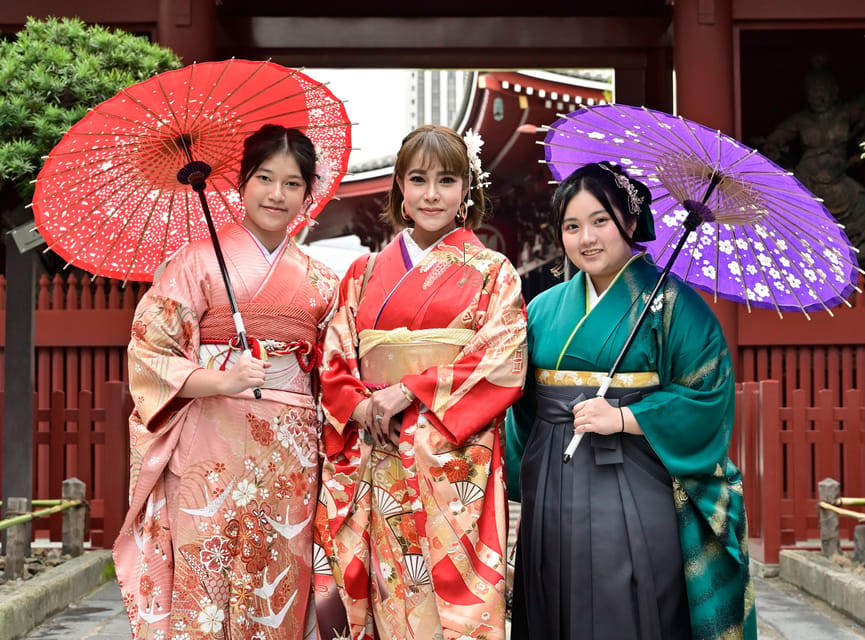
Tokyo: Asakusa Kimono Dressing and Matcha Experience
Get dressed in a kimono in Asakusa, with a matcha break, then keep it on for the walk up Nakamise to the temple.
4.9(280 reviews)
- 2 to 8 hours
- Free cancellation
From $43per person
See prices & availability
Tokyo: Asakusa Sightseeing Tour by Rickshaw
A rickshaw puller takes you around Asakusa and its back streets, from a 30-minute loop to a ride of about three hours.
4.9(251 reviews)
- 30 to 190 minutes
- Free cancellation
From $34per person
See prices & availability
Sumida River: Japanese Traditional Yakatabune Dinner Cruise
A 2.5-hour dinner on a traditional yakatabune boat on the Sumida River. Cancellation is not free, so book once dates are fixed.
4.6(982 reviews)
- 2.5 hours
From $100per person
See prices & availability
Senso-ji opening hours and entrance fee in 2026
Many searches ask for Senso-ji tickets, but there are none. The temple, the gates, Nakamise and the grounds are open to everyone at no cost, every day of the year. What the official site lists are the hours of the main hall, the only building with a door that closes:
| What | Hours or price |
|---|---|
| Grounds, Kaminarimon and Hozomon gates | Open day and night, free |
| Main hall (Kannondo), April to September | 6:00 to 17:00 |
| Main hall, October to March | 6:30 to 17:00 |
| Nakamise shops | Roughly 9:00 to 18:00, depending on the shop |
| Omikuji fortune slip | ¥100 ($0.60) |
| Goshuin temple stamp | About ¥500 ($3) |
The amulet counters close with the hall, at 17:00. The temple office answers the phone on 03-3842-0181 from 9:00 to 16:30, Monday to Saturday, but not on Sundays or public holidays. The address is 2-3-1 Asakusa, Taito-ku, Tokyo.
How to get to Senso-ji: Ginza Line, Asakusa Line and Tobu
Four lines stop at Asakusa Station, and from each the temple is about 5 minutes on foot. The Tokyo Metro Ginza Line is the one most visitors use, with exit 1 a short walk from Kaminarimon. The Toei Asakusa Line (exit A4) runs through to both airports, so from Haneda or Narita you can often ride to Asakusa without changing. The Tobu Skytree Line arrives from Nikko and the Tsukuba Express from Akihabara.
- From Ueno: Ginza Line, 5 minutes, or a 30 to 35 minute walk by Kappabashi.
- From Tokyo Station: JR Yamanote Line to Kanda, then the Ginza Line, about 20 minutes and ¥340 ($2) in total.
- From Shinjuku: about 25 minutes, by the Chuo Line and the Ginza Line, or the Oedo Line and the Asakusa Line.
- From Tokyo Skytree: one stop on the Asakusa Line from Oshiage, or a 15 to 20 minute walk across the river.
A Suica card on your phone works on all four lines. There is no parking at the temple, and the temple points drivers to the underground Taito Kaminarimon car park, but the subway is far easier.
What to see at Senso-ji, from Kaminarimon to the pagoda
Legend says two fishermen brothers found a small statue of Kannon, the bodhisattva of mercy, in their nets on the Sumida River in 628, and the temple grew around it. Almost everything you see was rebuilt after the air raid of 10 March 1945, in the same style. Walk it in this order, from south to north.
Kaminarimon, the Thunder Gate
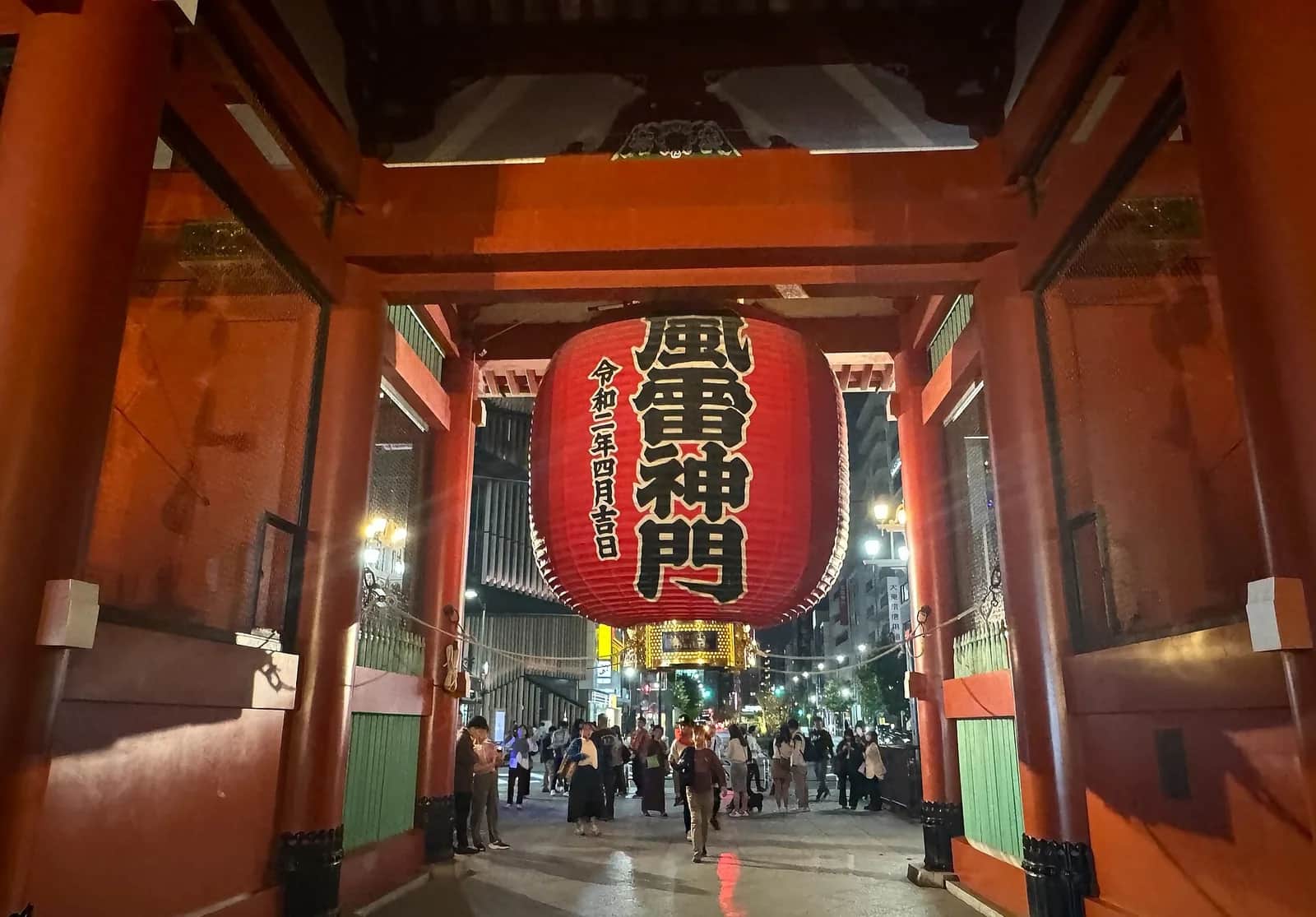
The outer gate dates back to 942, burned down in 1865 and was rebuilt in 1960 with a donation from Konosuke Matsushita, the founder of Panasonic. The wind god Fujin and the thunder god Raijin guard it on either side. The red lantern weighs around 700 kg and is about 3.9 m high. Look under it: the wooden dragon carved on its base is easy to miss. The photo in front of the gate is busiest from 10:00, so come early or after dark for a clear shot.
Nakamise-dori, the shopping street to the temple
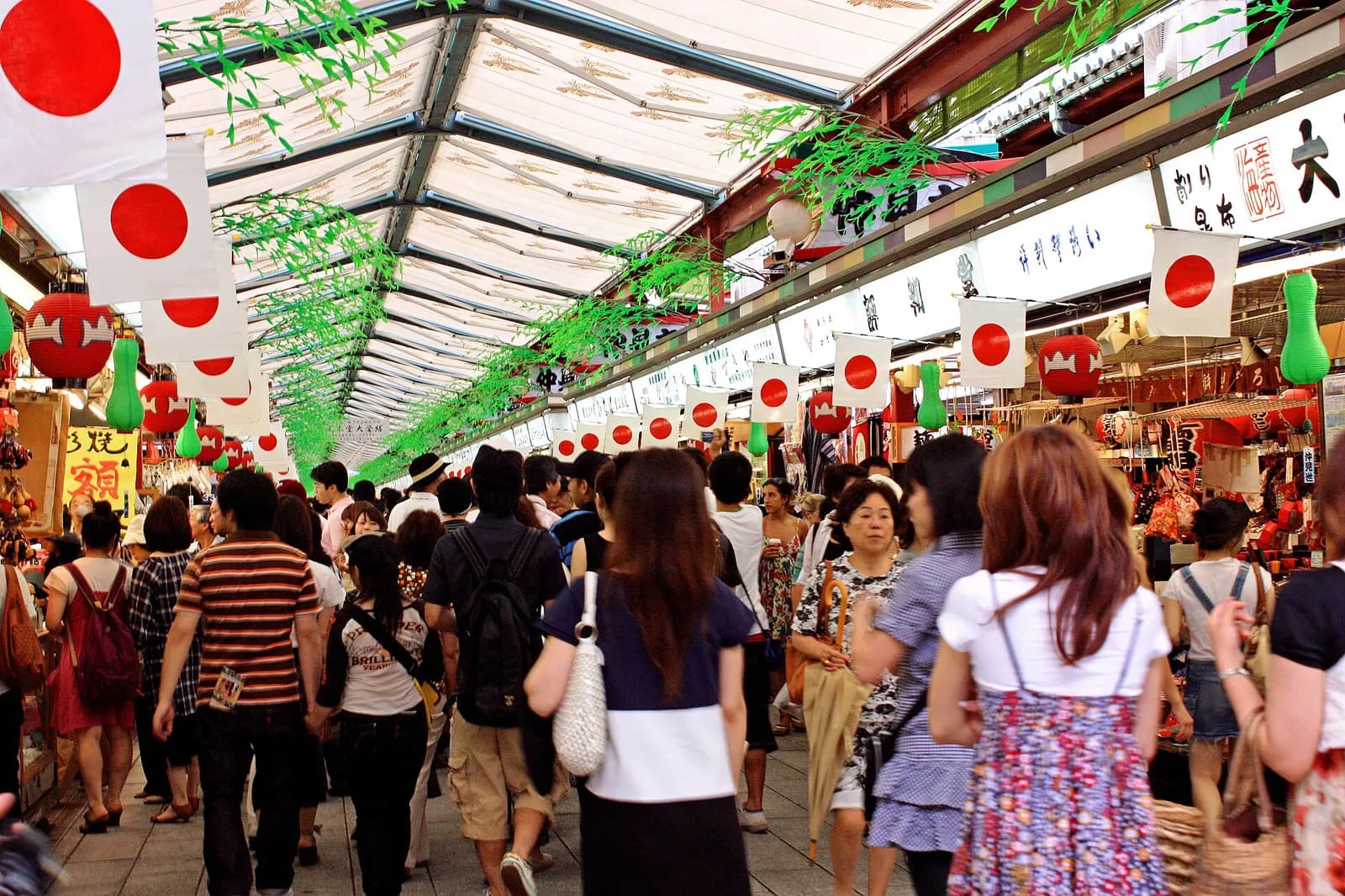
Nakamise runs about 250 metres from Kaminarimon to the second gate, lined with dozens of small shops selling rice crackers, sweets, fans, folding screens and souvenirs. It is one of the oldest shopping streets in Japan. Eat your snack next to the stall that sold it, not while walking: it is the local habit, the street is packed shoulder to shoulder by late morning, and there are almost no bins. The side streets east and west of Nakamise are quieter and often cheaper.
Hozomon, the treasure gate
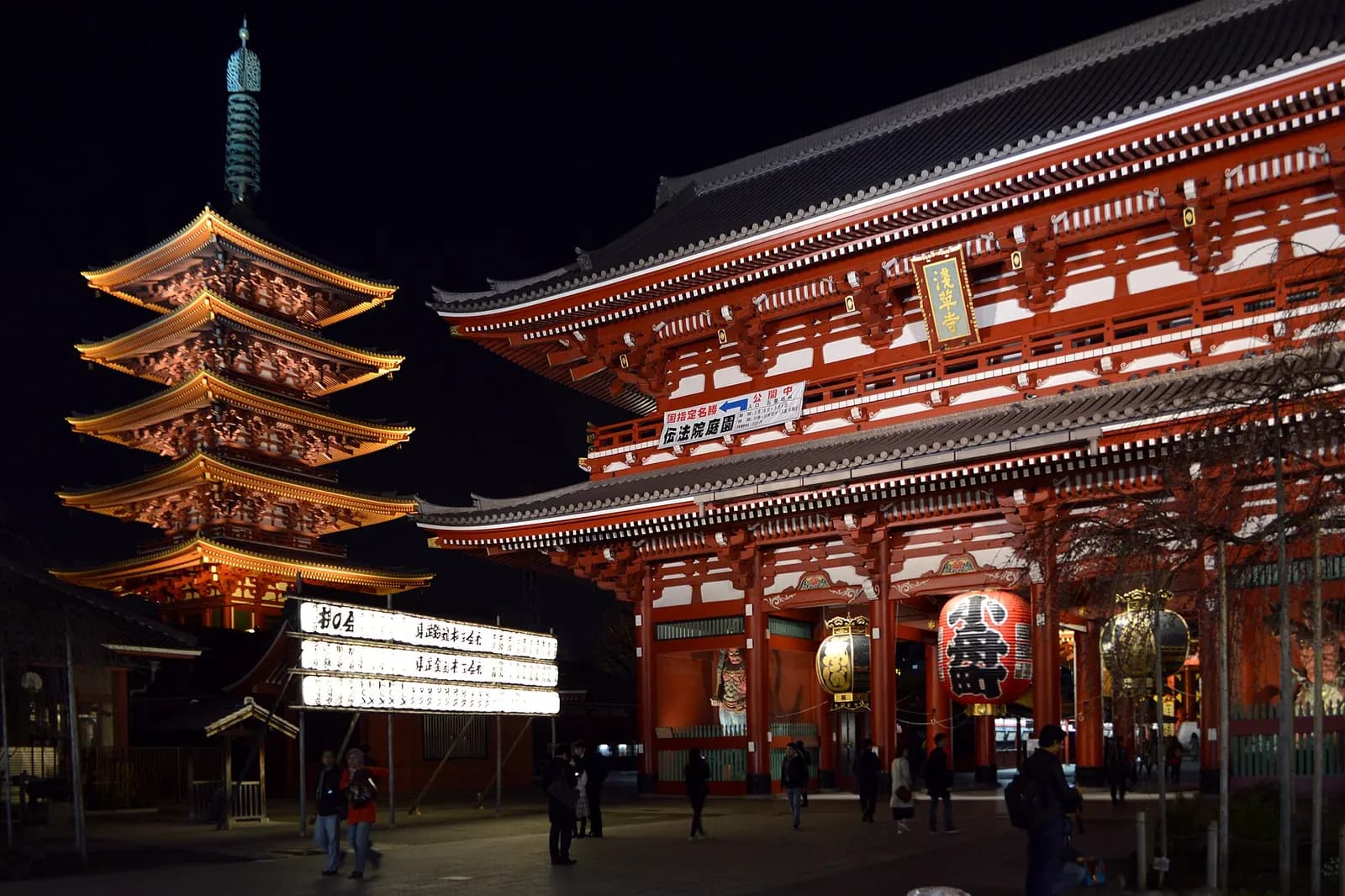
The two-storey Hozomon, rebuilt in 1964, holds the temple's sutras on its upper floor. Two muscular Nio guardians stand at the front, and on the back hang huge straw sandals, a gift from a town in Yamagata, meant to show that guardians this size protect the temple.
The main hall (Kannondo)
The hall was rebuilt in 1958. The statue of Kannon found in the river is never shown to the public. It stays behind locked doors. You can walk in, toss a coin in the offering box, put your hands together and bow. Take your hat off inside and keep your voice low: it is a working temple, and people come here to pray, not only to look.
The five-storey pagoda
To the left of the hall stands the pagoda, about 53 metres high and rebuilt in 1973. Its top floor keeps relics of the Buddha given by a temple in Sri Lanka. The inside is closed, so you see it from the path, best in the late afternoon light or once it is lit at night.
Asakusa-jinja, the shrine next door
Behind the hall on the right is Asakusa Shrine, a Shinto shrine built in 1649 under the shogun Tokugawa Iemitsu and one of the few buildings that survived 1945. It honours the two fishermen and the man who first enshrined the statue, and it is the shrine, not the temple, that holds the Sanja Matsuri. Its office is open from 9:00 to 16:00 on weekdays and to 16:30 at weekends.
Denbo-in garden: closed to the public
The residence of the chief priest has a garden from the early Edo period, attributed to Kobori Enshu and listed as a national scenic site. The temple states that the garden is closed to the public, with occasional special openings, and none was announced for 2026 when we checked. You can glimpse its walls from Denboin-dori, the shopping street to the west.
Senso-ji etiquette: incense, omikuji and photos
At the big bronze burner in front of the hall, buy a bundle of incense, light it, drop it in and wave the smoke towards you. People believe it heals the part of the body it touches, so you will see visitors fanning it onto their heads and shoulders.
The omikuji stands are on both sides of the hall. Drop ¥100 in the slot, shake the metal box until a stick comes out, read its number and take the paper from the matching drawer, with an English translation on the back. Senso-ji is known for giving a lot of bad fortunes. If yours is bad, the custom is to tie it to the metal rack nearby and leave the bad luck at the temple. A good one goes home with you.
Photos are fine in the grounds and from the steps of the hall. Inside, keep your camera down while people are praying, and never block the offering box for a picture. Leave space on the path in front of Kaminarimon, where everyone stops at once.
Best time to visit Senso-ji to avoid the crowds, and Senso-ji at night
Go before 8:00. At that hour the hall is open, the shops on Nakamise still have their painted shutters down and you meet locals on their way to work rather than tour groups. From 10:00 to 16:00 the street is packed, and weekends are worse than weekdays.
The second good window is after dark. The hall, Hozomon and the pagoda are lit every evening, until around 23:00 according to local guides, and the grounds empty fast once the hall closes. The Nakamise shutters, painted with scenes of Asakusa through the year, are worth the walk on their own. Avoid the first week of January, when millions come for the New Year prayers.
Senso-ji festivals and events: Sanja Matsuri, Hagoita-ichi and New Year
| Event | Dates | What happens |
|---|---|---|
| Hatsumode (New Year) | 1 to 7 January | The first prayers of the year, with the biggest crowds of the year |
| Setsubun | Around 3 February | Bean throwing, with a wish for long life instead of the usual chant against demons |
| Kinryu no Mai (golden dragon dance) | 18 March and 18 October | A golden dragon dances through the grounds |
| Shirasagi no Mai (white heron dance) | Second Sunday of April and 3 November | Dancers dressed as white herons parade around the temple |
| Hana Matsuri | 8 April | The Buddha's birthday |
| Sanja Matsuri | 14 to 16 May 2027 | Asakusa Shrine's festival, with about a hundred portable shrines carried through the streets |
| Hozuki-ichi | 9 and 10 July | A market of lantern plants. A prayer on these days counts for 46,000 days |
| Hagoita-ichi | 17 to 19 December | Stalls selling decorated battledores, a New Year charm |
The Sanja Matsuri is the big one. For 2027, Asakusa Shrine announces 14 to 16 May: a parade of dancers and musicians on the Friday from 13:00, the neighbourhood shrines on the Saturday, then the three main portable shrines leave at 7:00 on the Sunday and return around 19:00 to 20:00. Hotels in Asakusa fill early that weekend, so our guide to where to stay in Tokyo is worth reading months ahead. In late March and early April, Sumida Park, a few minutes east of the temple, is one of the classic spots in our cherry blossom guide.
Things to do near Senso-ji: Kappabashi, Skytree and the Sumida River
Tokyo Skytree
The 634-metre tower stands across the Sumida River, a 15 to 20 minute walk over Azuma Bridge, or one stop on the Asakusa Line. It is the natural second half of the day after the temple, and our Tokyo Skytree guide covers tickets, the two decks and the best time to go up.
Kappabashi Kitchen Street
About 600 metres west of the temple, this street of wholesale shops sells knives, ceramics, lacquerware and the plastic food models you see in restaurant windows. Shops open roughly from 9:00 to 17:00, and many close on Sundays and public holidays, so go on a weekday.
The Sumida River and its boats
From the riverside near Azuma Bridge, sightseeing boats leave for Hamarikyu Gardens and Odaiba, a calm way to reach central Tokyo. In the evening, yakatabune dinner boats sail the same stretch with views of the Skytree.
Hanayashiki and Hoppy Street
Hanayashiki, just north-west of the temple, is a small amusement park dating back to 1853, with the oldest roller coaster in Japan, running since 1953. It opens from 10:00 to 18:00 on most days, with last entry 30 minutes before closing, and adult entry is ¥1,600 ($10) on the park's fee page, with rides paid on top or a ¥4,600 day pass that covers both. On the way, Hoppy Street is a row of open-air izakaya serving beef stew and cheap beer, busy from the afternoon.
Where to eat near Senso-ji
Nakamise is for snacks: ningyo-yaki (small sponge cakes filled with red bean paste, cooked in front of you), kibi dango on skewers, melon pan and freshly grilled rice crackers. For a sit-down break, the old tea rooms and sweet shops around the temple serve anmitsu and green tea, and the streets west of Nakamise are full of tempura rice bowls, soba and monjayaki. Asakusa is one of the cheapest areas in central Tokyo to eat, with lunch sets often under ¥1,500 ($9).
How long to spend at Senso-ji
One hour covers the gates, Nakamise, the hall, the pagoda and Asakusa Shrine at a steady pace. Allow two hours with snacks, an omikuji and the side streets. Most visitors make Asakusa a half day: Senso-ji early, Kappabashi or the river, then Skytree in the afternoon. Our guide to things to do in Tokyo groups Asakusa with Ueno on the same east-side day, and our Japan itinerary shows where that day fits in a first trip.